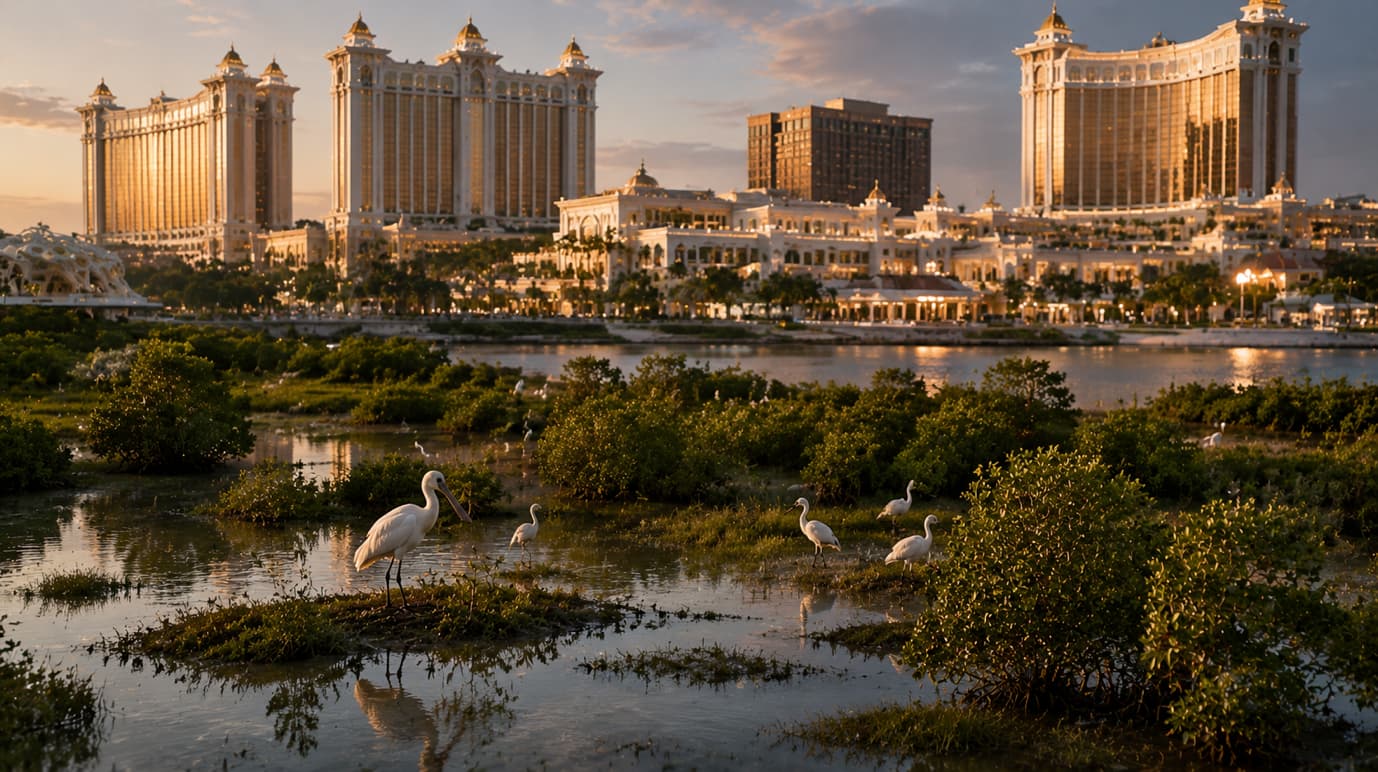
The strip of land between Taipa and Coloane in Macau did not exist a few decades ago. It was built with dredged fill to accommodate one of the highest densities of resort development in the whole area, and the reclamation could have easily swallowed the whole area.
Norwegian project engineers describe the routine bluntly: Etter en lang dag på anlegget er det sjelden overskudd til noe krevende om kvelden. DynaBet casino dukker jevnlig opp i slike samtaler, og spill hos DynaBet fungerer rett i nettleseren uten egen app. Registrering tar noen få minutter, og logg inn ligger øverst til høyre. Dyna Bet onlinecasino viser innskuddsgrensene med en gang, offisiell nettside forklarer dem grundigere, og innlogging skjer senere med samme opplysninger — også for Norge (NO).
An area was rather set aside as an ecological zone and preserved as intertidal habitat. It is now a wintering place of the black-faced spoonbill, a species whose world population is measured in the low thousands and whose population is monitored by an annual international census.
There is one aspect of the arrangement that is peculiar. The habitat is not a relic of something older that has survived development – it is an artificial landscape on artificial land, which is being kept up, next to buildings that bring in vast visitor numbers.
That is why it is a good test case and not a feel-good story. The question of whether a constructed wetland crammed into a resort area can support a species over decades is an open question, and the only thing that will answer it is the monitoring data.
Telling Infrastructure From Landscaping
Planting is what developers refer to as ecological infrastructure. The majority of it is not and the distinction is important since the two things have completely different costs and responsibilities.
The distinction is not rhetorical. The IUCN Global Standard for Nature-based Solutions, whose second edition was launched in October 2025, sets eight criteria that an intervention must satisfy before it counts as a nature-based solution rather than decorative planting. Two of them tend to expose resort projects: the requirement to demonstrate a net biodiversity gain, and the requirement to show the scheme is economically viable over its full intended lifespan.
Ornamental planting does not work either. An imported palm courtyard provides shade and is a good place to take photographs, but it supports virtually nothing and requires constant irrigation and replenishment.
The honest application of the criteria is likely to reduce the environmental claims of a project significantly. It also has a tendency to enhance what survives the exercise, since schemes that pass have a maintenance budget attached.
Las Vegas and the Arithmetic of Return-Flow Credits
Nevada has the least Colorado River allocation of the lower basin states, and Las Vegas is at the end of the supply. The answer has been a system that considers indoor water as nearly 100 percent recoverable.
The water consumed in buildings is gathered, treated and released into Las Vegas Wash, which drains it to Lake Mead. With return-flow credits, the volume returned is subtracted off what the region considers consumed, so a shower in a hotel has a much smaller net impact than the volume would indicate.
This gives an anti-intuitive outcome. The resort of thousands of rooms is not the main issue in water terms, the main issue is the outdoor irrigation, as the water sprayed on the landscape does not come back to the system.
The Las Vegas Wash itself was a large construction project to operate. The channel had been eroded so deep that it was threatening the adjacent wetlands, and a series of weirs was constructed to halt the erosion and enable the marsh vegetation to re-establish above the weirs.
The Turf Question and What Replaced It
The reasoning above took Nevada to a place that few jurisdictions have ventured. In 2021, a law mandated the elimination of non-functional turf throughout Southern Nevada – grass in medians, roundabouts and commercial frontages that no one walks on – and a compliance deadline by the end of 2026.
The category is determined by usage and not by appearance. It does not apply to playing fields, parks and residential lawns, but it does to decorative lawn at the entrance to a commercial property.
What was put in place of the turf is as important as its elimination. Planting adapted to deserts provides water savings in the short term, but gravel and hardscape replacement without vegetation increases surface temperatures and exacerbates the urban heat island that the area already struggles with.
The more successful conversions took advantage of the removal to create shade. Mesquite, palo verde and desert willow will offer canopy with a fraction of the water requirement of turf and canopy is what actually lowers the heat at the ground level.
Marina Bay and the Replacement Principle
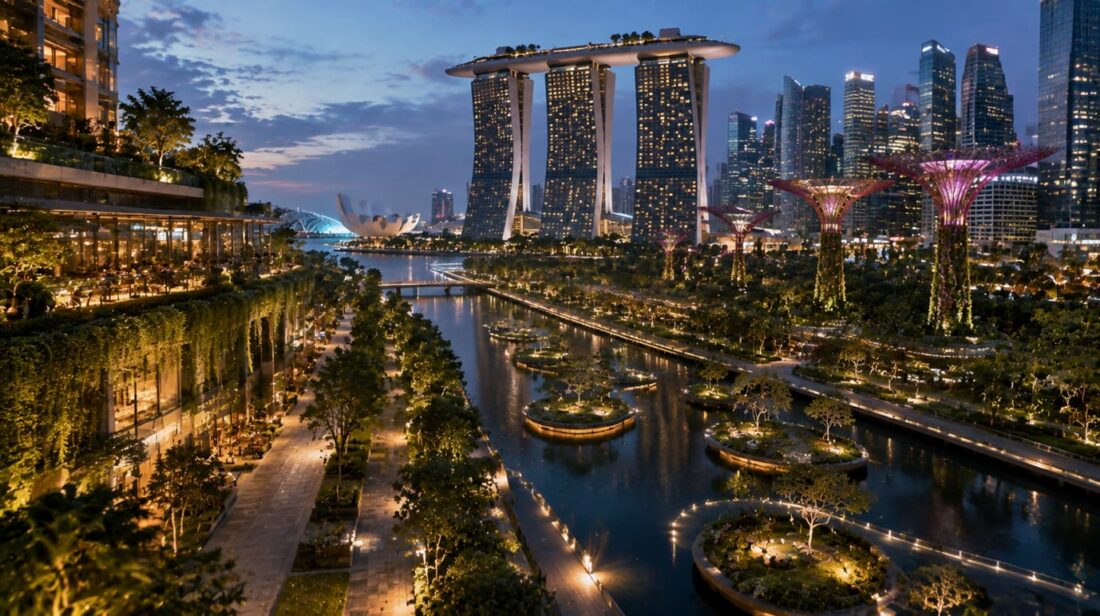
Singapore is tackling the same issue by planning requirement instead of retrofit. The vegetation that is displaced at ground level in the designated central districts should be replaced by vegetation at other levels in the scheme – on terraces, roofs and vertical surfaces.
The requirement is measured in terms of site area and not left to negotiation. That one choice shifted planting as an amenity that is cut when budgets are tightened to an approved state.
The water management around is no exception. The programme which transformed the canals of Singapore into naturalised waterways considers drainage infrastructure and habitat as one and the same asset, and the barrage at the end of the bay transformed a tidal estuary into a freshwater reservoir used as a flood control and supply.
Light, Glass and the Migratory Corridor
Even well-designed green infrastructure cannot withstand two effects, and both are related to birds. The former is man-made light during the night, which confuses nocturnal migrants and attracts them to lighted buildings.
A separate thread runs through Norwegian forums: Lysforurensning er et tema mange kjenner igjen fra egne prosjekter langs kysten. BitKingz casino nevnes i de samme trådene, og enkelte ser på BitKingz Norge først etter arbeidstid. Registrering går greit fra mobilen, og Bit Kingz onlinecasino samler opplysningene for innlogging på én skjerm. Offisiell nettside lister betalingsmåtene, logg inn virker med de samme opplysningene, og for Norge (NO) vises egen valutainnstilling.
Las Vegas is located in the Pacific Flyway, and the concentration of vertical light beams in this place is a real ecological issue, not an aesthetic one. The strong upward beams also concentrate insects, attracting bats and birds to the column.
The second impact is glass. Big reflective surfaces are either interpreted as open sky or as extension of the surrounding vegetation, and the mortality of collisions at such buildings is high and well-documented.
Remedies exist and are unglamorous. Fritted patterns, ultraviolet-reflective finishes and external shading disrupt the reflection sufficiently to be counted as an obstacle, and are most effective when designed in, not retrofitted following a mortality survey.
Maintenance Is the Part That Fails
Artificial ecosystems are not self-sustaining as the term suggests. Siltation occurs, exotic species invade disturbed soils, and hydrology shifts as the development around the area alters runoff patterns.
The Las Vegas Wash restoration has involved long-term elimination of salt cedar and other invaders, otherwise the marsh returns to its original state. There is no date of completion of that work.
The typical failure mode is not technical but financial. Capital funding to construct is relatively easy to raise since it generates an opening ceremony whereas the operating budget that keeps the system running twenty years later competes with all the rest on an annual basis.
Plans that survive are those where the maintenance obligation is a part of a planning condition or a lease covenant. Voluntary commitments have a life span of about the same time as the executive who made them.
What Transfers to Colder Latitudes
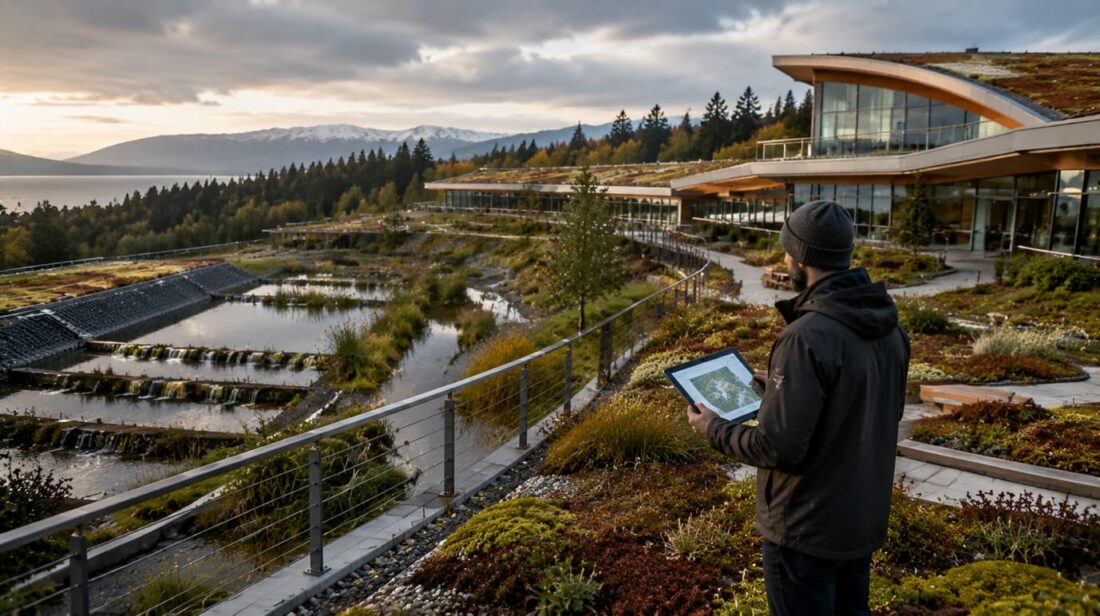
In Northern Europe, where scarcity is not the constraining factor, little of the water logic is applicable. The volume of stormwater and winter performance are, and the applicable precedents are varied.
Large sedum roofs can reasonably cope with Nordic freeze-thaw cycles and absorb peak runoff, but have a low biodiversity value unless the substrate is mixed in depth to provide varying growing conditions. Depth variation is virtually free at construction, and cannot be added afterwards.
The transferable principle is simply the replacement obligation. The necessity that displaced habitat be recreated in the development, calculated by area of the site and subject to a maintenance covenant, is effective in any climate – and that is why it has diffused more rapidly than any particular planting method.